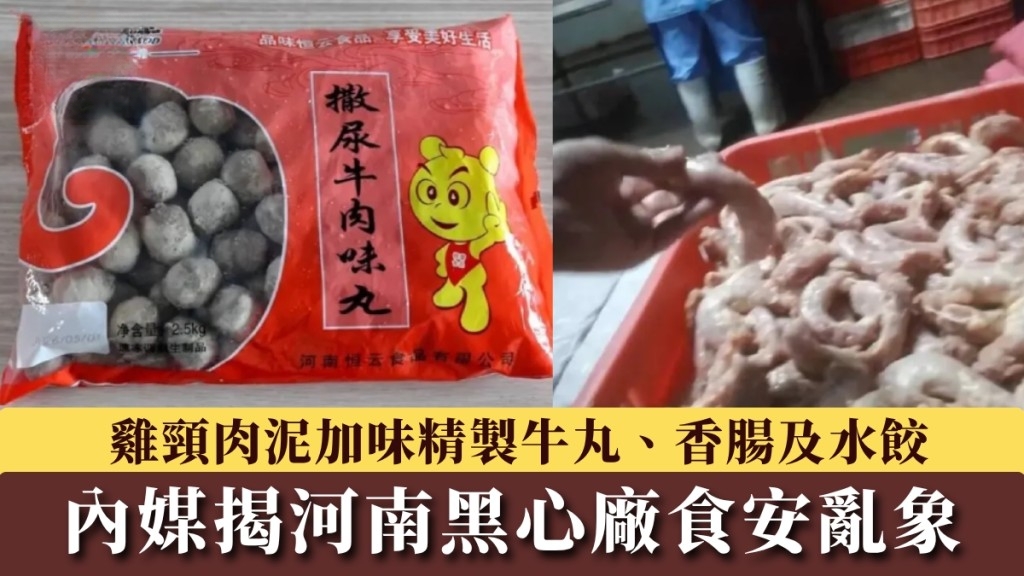
Safety scandal erupts in Henan province as media outlets uncover dubious practices in meat processing. In recent undercover investigations, it was reported that several factories in Henan specifically collect leftover parts such as skin-on chicken necks and chicken shells from slaughterhouses, transforming them into "meat slurry" and selling to downstream manufacturers to produce sausages, dumplings, and even "silly cow beef-flavored balls." The practice has raised significant concerns about meat safety and food labeling. In one instance, a factory owner candidly advised, "Avoid products with fillers as much as possible." The city of Luohe, known as the "food city," boasts over 7,000 food manufacturing companies with leading production of sausages nationwide. Investigations revealed that many upstream factories process these leftover parts into "chicken neck slurry" and "chicken bone slurry." For example, the "Chenlu Food Co., Ltd." in Luohe states that its factory produces at least 30 tons daily, with each ton priced at just 3,800 RMB (approximately 1.9 RMB per pound). Faced with strict regulations, a significant portion of this slurry is sold to manufacturers in Luohe and other areas for producing sausages, meatballs, and frozen dumplings. Downstream factories, however, denied using chicken neck slurry despite the evidence. Moreover, some companies directly admit their reliance on chicken neck slurry for making "beef-flavored" products, highlighting the use of flavor enhancers to mimic beef flavor. This lack of transparency has raised serious ethical questions and health concerns among consumers.
The industrial sector in Henan has long faced a dearth of oversight and regulation, especially in relation to the transformation of meat by-products into consumer products. Following rigorous investigations, it emerged that many companies, particularly in Luohe and its neighboring regions, operate without necessary licenses, making it difficult for the authorities to enforce any regulations. The local market supervision bureau and agricultural departments fail to agree on jurisdiction, contributing to the chaos. The absence of proper health and safety checks, including the detection of volatile amines, further amplifies the risks. Despite the existence of industry standards, the gap in enforcement remains a black hole in food safety, leaving consumers in the dark about the true contents of their food products.