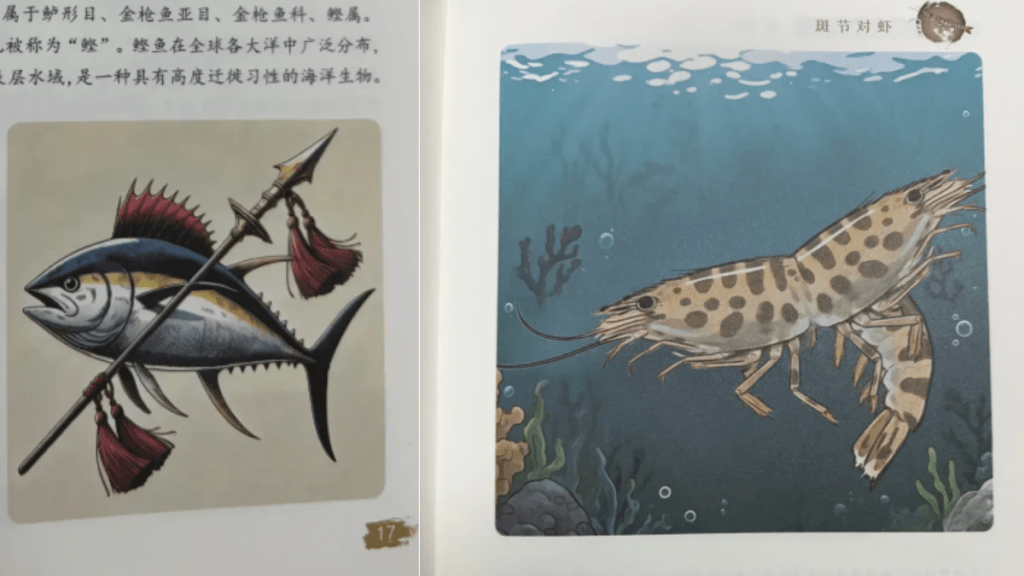
Recently, netizens have raised concerns over illustrations in The South China Ocean Biological Science Series, published by China Agriculture Press. The book includes unrealistic images such as 'two-headed shrimp' and 'giant mackerel carrying a crimson spear', sparking widespread debate. Notably, the series was even selected as one of the top 100 outstanding science popularization works in China this year, but it is now being completely removed from online sales. Netizens argue that the publishers lack basic knowledge of marine biology. The book's first volume features a 'giant mackerel' page accompanied by an illogical illustration of a 'human-headed fish' and 'mackerel with a crimson spear', which sparked questions from netizens such as: "Is a giant mackerel a fish carrying a crimson spear?" Additionally, the volume on '斑节对虾' (Banded Prawn) features a 'two-headed shrimp' on its cover and inner pages. Notably, the book's preface specifically states, 'All the illustrations in this series were generated using AI drawing tools, for your reference.' Many readers have expressed strong doubts about the quality of the publication, suggesting that while using AI is acceptable, the images must be at least consistent with basic marine biology facts. Others argue that the review mechanism appears ineffective, stating that the illustrations are unsettling.
The case is particularly ironic as the series was recently included in the top 100 outstanding science popularization works in China for 2026. However, due to the inclusion of strange AI-generated illustrations, it has been withdrawn from sale. A spokesperson from the publisher, China Agriculture Press, confirmed that they have been made aware of the situation and are currently notifying all online platforms to recall the affected books. Readers who have already purchased the book can apply for a refund through the purchase platform. Currently, the official WeChat mini-program and flagship store of the publishing house no longer feature the book. Notably, the series, edited by Zhou Shengjie, Ma Zhenhua, and Wu Qia'er, was published in December 2024, and its inclusion in the 2026 outstanding science popularization works list made the controversy all the more striking given the bizarre illustrations.