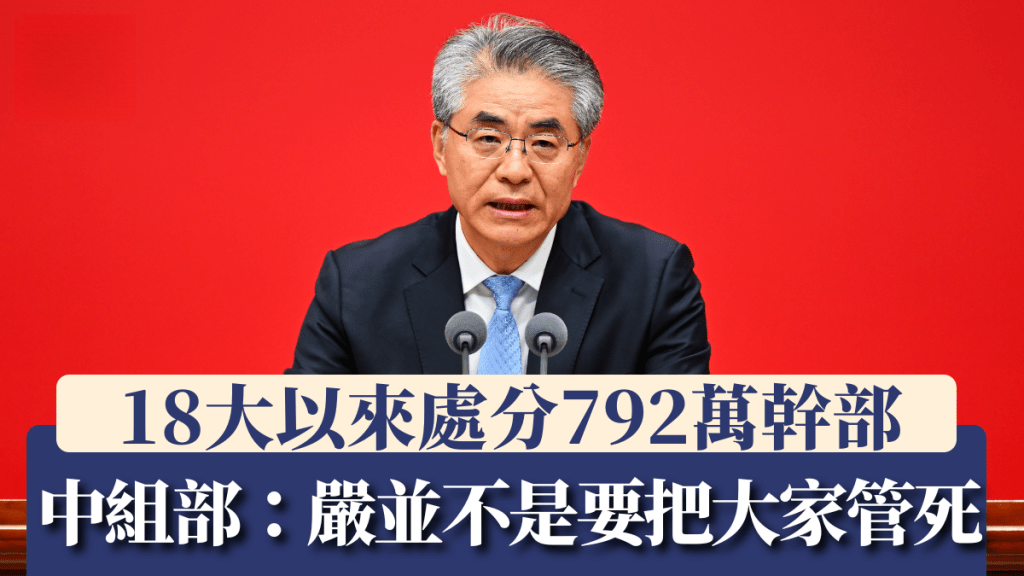
The Fifth Plenary Session of the 20th Central Committee of the Communist Party of China (CPC) concluded yesterday, praising the major achievements made in comprehensively enforcing strict party discipline since the 18th CPC National Congress in 2012. According to discipline inspector officials, between 2012 and now, more than 792,200 people, including 963 'central-level cadres' (usually at or above the vice-ministerial level), have been disciplined by the disciplinary inspection and supervision organs. The Department of Organization of the Central Committee official stated that comprehensive strict party discipline is not to 'keep everyone under tight control', but to form a clear and positive political environment. 'Severe management is actually a form of caring. For cadres, strict management is both a restriction and a protector,' the official said. The session adopted a decision on persistently promoting comprehensive strict party discipline, emphasizing that corruption issues have been addressed since the 18th National Congress, rectifying issues such as weakened and diluted party leadership. It stresses maintaining the centralized and unified leadership of the CPC Central Committee over anti-corruption efforts. On the same day, the CPC Central Committee held a press conference to explain the meeting content. Deputy Secretary of the Central Commission for Discipline Inspection and Deputy Head of the National Supervisory Commission, Zhang Fuhai, added that between 2012 and now, 1.644 million cases of the 'four winds' (formalism, bureaucratic behavior, hedonism, and extravagance) were handled, involving 2.257 million people; 8.105 million cases were investigated, and 792,200 individuals were disciplined, with 963 being central-level cadres. He pointed out that the anti-corruption struggle is still severe and complex, and a high-pressure approach will be maintained, with a focus on addressing corruption in power-concentrated, capital-intensive, and resource-rich areas. Deputy Minister of the Department of Organization of the Central Committee Huang Jianfa emphasized that comprehensive strict party discipline primarily focuses on managing cadres strictly. However, strict party discipline is internally unified with encouraging cadres to take responsible actions. 'We must see that corruption remains a serious issue. Discipline enforcement is in place to protect and benefit honest officials,' the official said. The meeting document also addresses the issues of inaction and misconduct among some Party officials and outlines steps to encourage officials to take on responsibilities. Measures include strictly punishing false accusations, providing timely clarifications, and supporting officials who act in the public interest.
The document stresses that for officials, strict management is both an encumbrance and a safeguard. Cadres disciplined for corruption are seen as necessary to protect those who uphold integrity. The document's measures to encourage responsible actions and address false accusations contribute to creating a supportive environment for officials to carry out their duties. The overarching goal is to foster a clean political climate and environment that encourages the healthy and productive development of the Party and the country.