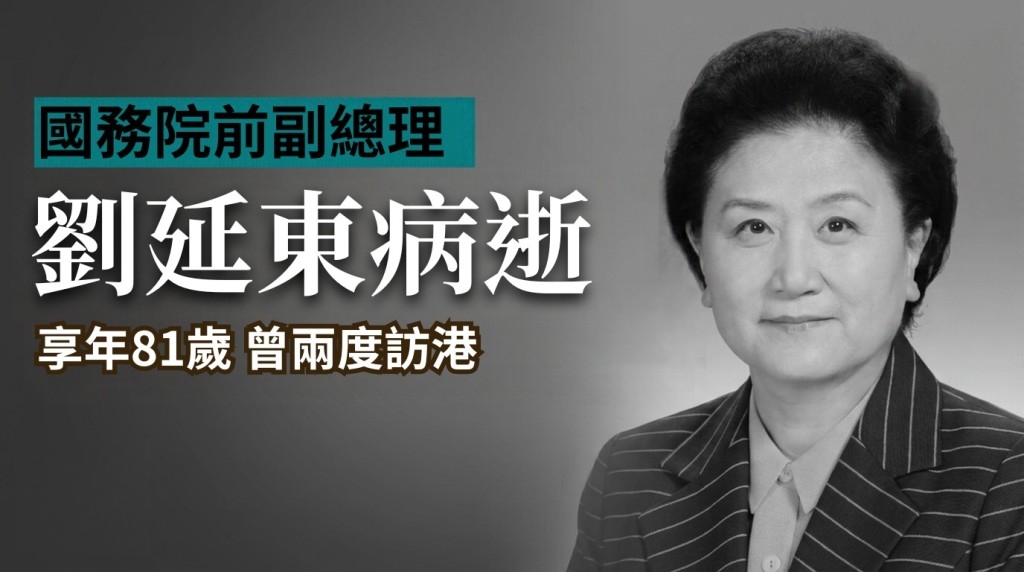
Li Yan Dong, a former vice-premier of the State Council and a former member of the Political Bureau of the Communist Party of China Central Committee, passed away in Beijing on February 28 at the age of 81. Li Yan Dong had close connections with Hong Kong and Macao, serving as the first female minister in the United Front Work Department of the CPC Central Committee and vice-chair of the Central Leading Group for Hong Kong and Macao Affairs. She paid two visits to Hong Kong in 2004 and 2009. The Xinhuashe reported on the evening of February 28 that Li Yan Dong had passed away at 2:53 PM due to illness, at the age of 81. It described her as an "outstanding Party member of the Chinese Communist Party, a faithful communist fighter tested by many trials, an outstanding leader in the fields of United Front work, education, science and technology, healthcare, and women and children's affairs." Born in November 1945 in Nantong, Jiangsu, she was the daughter of Liu Ruilong, secretary-general of the Shanghai Municipal Committee and a deputy minister of agriculture, making her part of the 'Red Second Generation'. She studied chemical engineering at Tsinghua University. In the 1980s, she worked in the Communist Youth League, eventually serving as a secretary of the youth league, deputy secretary, deputy chair, and chair. In 1991, she transferred to the United Front Work Department of the CPC Central Committee, becoming the vice-secretary and deputy minister. During the 16th CPC National Congress in 2002, Liu Yan Dong rose to become the minister of the United Front Work Department and subsequently assumed additional posts as a vice-chairman of the National Committee of the Chinese People's Political Consultative Conference, elevating her to the ranks of principal Communist Party and state leadership. In May 2004, Liu Yan Dong, as the minister of the United Front Work Department, made a five-day visit to Hong Kong where she attended and presided over the unveiling of relics from the Famen Temple in Xi'an. Her visit included meetings with prominent figures in Hong Kong and her 16-character message to the people there: "rooted in patriotism, prioritizing unity, focusing on development, and upholding self-reliance." In December 2009, she visited Hong Kong again for the opening ceremony of the East Asian Games. In 2012, during the 18th CPC National Congress, she re-joined the Political Bureau, and the following year she was named vice-premier in charge of education, science and culture, as well as vice-chair of the Beijing Olympic Games Organizing Committee.
She became the fourth female vice-premier of the People's Republic of China (after Wu Guixian, Chen Mouhua, and Wu Yi) in March 2018 when she stepped down from the post of vice-premier at the age of 72.
Despite her decline in health, she remained an influential figure in Chinese politics until her retirement.