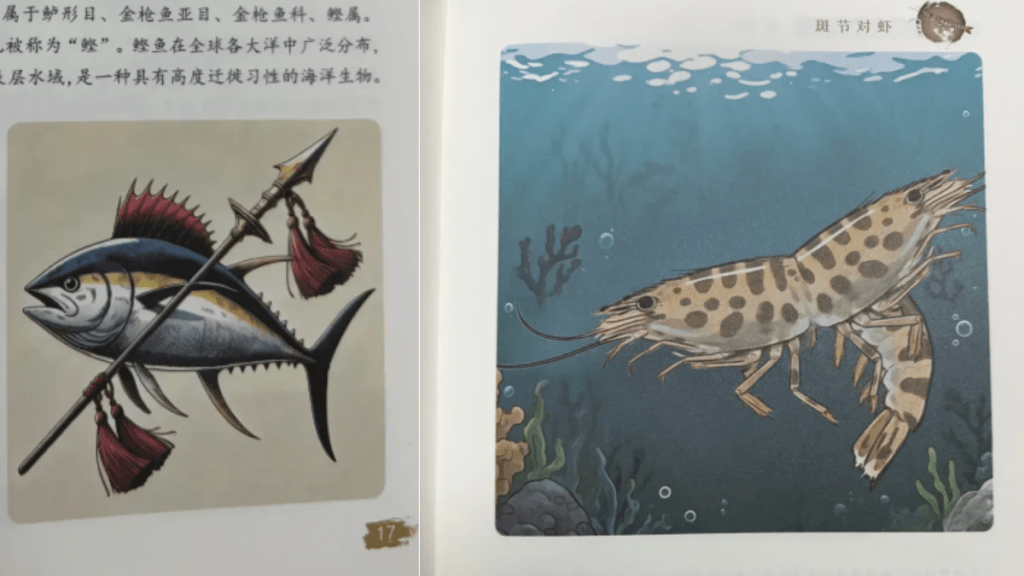
Recently, netizens on social media exposed a bizarre illustration in the "South China Sea Marine Biology Popular Science Series," published by China Agricultural Press. The book's illustrations featured absurd images such as "double-headed shrimp" and "golden sash swordfish carrying a spear." Astonishingly, despite its selection as one of the "2026 National Outstanding Popular Science Books," the book has been entirely removed from e-commerce platforms. Commentators argue that the illustrations betray a profound lack of marine biology knowledge. One netizen remarked, "Is the golden sash swordfish supposed to be carrying a spear?" Another pointed out that the dual-headed shrimp illustration is particularly disturbing and questioned the effectiveness of the review process. On October 27th, a spokesperson from China Agricultural Press acknowledged the issue and stated that they have instructed the wholesale removal and recall of all copies of the book, allowing customers to apply for returns if they have purchased the book. Notably, the book series, edited by Zhou Shengjie, Ma Zhenhua, and Wu Qiaer and due to be published in 2024, had recently won an award for being one of the "2026 National Outstanding Popular Science Books," further highlighting the irony of the situation.
The publication of this book series poses significant questions about the quality control and oversight in popular science literature, given the stark contrast between the national recognition it received and the critical feedback regarding the illustrations. Many readers emphasize the importance of accuracy and scientific integrity in these educational materials, suggesting that even with AI-generated images, human oversight is essential to maintain quality. The controversy has sparked discussions about the standards of such publications and the potential impact on public understanding of marine biology.
The bizarre illustrations have become a focal point of discussion, drawing attention to the potential consequences of relying on AI for image generation in educational materials. Critics argue that these images not only misrepresent marine creatures but also contribute to a misinformative perception among readers. This incident serves as a cautionary tale about the need for rigorous editing and fact-checking in educational publications, particularly those recognized nationwide. Moreover, it highlights the ongoing challenge of ensuring the accuracy and scientific validity of AI-generated content.