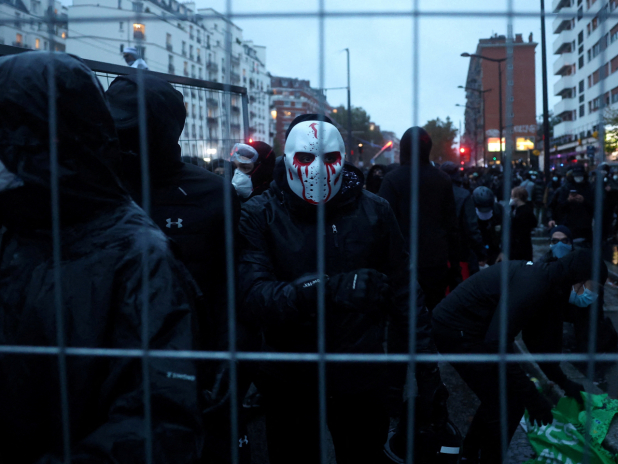
Clashes erupted across France as protesters took to the streets, following a week of violence and security crackdowns related to President Emmanuel Macron’s policies. Police arrested nearly 1,000 people during protests in multiple cities, including Paris, Marseille, Lyon, and Nantes, as the interior minister noted an "extremely elevated level of violence" from protesters. Two people sustained serious injuries: one in Toulouse with reportedly blown-off fingers, and another in Clermont-Ferrand. Security measures included deploying 70,000 personnel to protect over 410,000 to 800,000 participants across France, according to various estimates. In Paris, shops were boarded up and museums closed as the main march passed largely peacefully under strict authorities' control. However, clashes resumed after the march as police used tear gas and batons against protesters. In Nantes, thousands broke through police lines to reach the city center. Tensions were further fueled by the call for continued protests targeting Macron’s policies, with far-left candidate Jean-Luc Mélenchon vowing that the demonstrations will "repeat every week." This unrest highlights the political tensions ahead of the upcoming election, with rising inflation and student demands for better conditions contributing to growing public discontent.
Protests in other European countries, including Italy, Belgium, Spain, and Portugal, mirror similar issues such as inflation and education, albeit with distinct local concerns. The French unrest underscores a broader regional challenge regarding government measures and public dissent, especially as presidential elections approach. With Macron’s government facing increasing criticism, the ongoing protests will likely shape the political landscape in the coming months.
The demonstration also garnered international attention, with Mélenchon calling for weekly protests and the far-right National Rally leader Marine Le Pen using the event to kick off her campaign. Counter-protests by anti-fascist demonstrators in Orleans further demonstrated the polarizing nature of the current political climate in France. As the country strains under economic pressures, the government’s response to protests will be crucial in maintaining social stability leading up to the presidential election.